Twitter

Saturday, 31 May 2014

The Empathy Frag – making connections in video games


Lists are useless but fun. A year or so ago I compiled a personal Top 25 Games list. Picking them was relatively easy, although the order changes every time I look at it. I keep in mind how they hold up today, especially when sequels may have improved the base experience, but ordering is really an exercise in rating memories of my playing them first time around. As an iteration, Animal Crossing New Leaf is more streamlined than Wild World, and I’d certainly prefer it over the older game now, but the DS version was my first and made the first impression.

Rather than worry about an arbitrary order, I look for common themes linking the games. They fall broadly into three groups. The vast majority are favourites because of the worlds they present – I want to revisit those places (and I’ve written at length about those here). The second group could be categorised as ‘single-player narratives’, meaning one-off stories to progress through in a linear manner. Much of the time these two groups overlap.

The third category revolves around social experiences or multiplayer and it is the smallest, for several reasons. Hardware and peripheral requirements for multiplayer games haven’t always been easy to come by. Extra pads, link cables, monitors, copies of the game, etc were expensive, and as great as Four Swords Adventure may be, having a GameCube plus four GBAs (let alone the requisite enthusiastic participants) was a pipedream back in 2005.

I’m also only a recent convert to PC gaming, Steam having taken away the tech niggles and issues that had kept me away. Therefore, I have never gone in for MMORPGs or arena FPSs. As someone whose multiplayer experience had always been local, competitive online gaming seemed harsh and impersonal.

Finally, multiplayer modes used to have a pretty poor hit rate when it came to entertainment. Now they have risen to take equal billing with the ‘Campaign’ but 20 years ago they were often thrown in at the end of development, a token gesture and a fluke if it turned out to be fun (see GoldenEye).

Modern Warfare: EXACTLY like modern warfare.
Looking at this smaller third group, Modern Warfare is present for two reasons: Captain Price (with the then-novel, bombastic, scripted-sequence Campaign) and online mutliplayer. I missed the Xbox Halo train, so this became my first real brush with broadband gaming. It took my GoldenEye splitscreen experience and injected next-gen resolution, speed and connectivity. The tension of inching towards a 7-kill streak (which called in a support chopper) made the few times I managed the feat some of the biggest dopamine hits I’ve had in front of a screen. I was never very good, but the comradeship between my small band of bros. kept me coming back and colours my memory of the game. Party voice-chat provided the living room atmosphere. Any dudebro homophobes were quickly muted. The thrill of working together, sharing info, covering corners and flushing out snipers outweighed even the pleasure of a sexy kill-to-death ratio (which often wasn’t so sexy). Communicating and sharing the experience was the real draw.

Left4Dead came next and jettisoned the kill count completely. It presented the zombie apocalypse canvas and blank archetypal characters and then took a back seat to let the group create the real narrative moments while the AI directed the horde. The game demanded cooperation. There was no room for cavalier Rambos – helping fallen comrades was the only way to survive. It was unlike anything I’d ever played and couldn’t be replicated without real companions and real connections. Promoting collaboration over competition between players elevated the experience above the core gameplay loop to something that felt meaningful on a human level. As an exercise in entertainment, the grave consequences of failure in an actual team combat scenario are forgotten but feelings of camaraderie, shared success and the bonds built by that success remain. And is that not a goal of art – to reflect to the receiver an authentic sentiment and encourage empathy? Nobody is suggesting that Bambi’s mum dying communicates the genuine grief of losing a parent, but it carries an echo of that feeling through the artist’s construction. FIFA can't capture the real energy of being on the pitch, nor can Rock Band replicate the full feeling of rocking out with a crowd of thousands, but it provides a window on the experience for those who may never otherwise feel it. Much of this experience relies on cooperative gameplay.

Beatles Rock Band: EXACTLY like being in The Beatles.
Saturo Iwata has described Miiverse, Nintendo’s latecoming take on a social portal, as an ‘empathy’ network, and while the word may seem mawkish, it is absolutely the right choice. It recognises that software encouraging collaboration and sharing leads to a more affecting experience than the endorphin rush of a kill streak. Animal Crossing’s multiplayer is little more than the ability to run around in someone else’s village, trade fruit and perhaps enter some sedate bug-catching contests, but you can learn a lot about a person from their town layout and the gestures they use to communicate. The game’s limited vocabulary becomes an empathetic device in itself that forces you to read between the lines as your silent companion keeps spinning on a certain spot or doing a specific gesture. The ability to draw a doodle and see a person’s handwriting on Miiverse and Swapnote (the latter now sadly neutered by a blanket response to the transfer of ‘inappropriate material’) instantly tells us more about that individual than a Yeah! alone ever could and makes the network social. That word has become synonymous with applications that list people and products and allow for only a very primitive form of self-expression through categorisation. A smiley and a Like are shorthand for a positive response but don’t allow for nuance. A friend loses their job or a loved one – Likes and sadfaces are ineffective in these contexts. Irony, too, is often lost in translation. The rise of the hashtag could be attributed to its effectiveness in explicitly conveying subtext (we’re still waiting for a sarcasm font). Ultimately social networks descend into a mush of inexpressive emoticons, LOLs and RIPs which relegate them to the role of perpetual greeting card, only expressing the vaguest general sentiments. This makes them ideal for marketing purposes but poor at facilitating deep personal connections. Without these connections, online forums of all kinds descend to a depressing level of playground bickering, proclamation and misunderstanding. It has been suggested that social networks are reducing empathetic development in children, and the addictive compulsion to check Facebook certainly tends more towards the ‘just-one-more’ behavioural loop of a CoD deathmatch than breeding flowers or trading turnips.

It seems quaint but it's surprising what people will do
if you just ask nicely. And moderate them bad apples.
But empathy can be found in the most unforgiving and surprising software. The party teamwork in CoD can turn a spawn-die-spawn-kill cycle into something far more meaningful and pleasurable. Dark Souls has a reputation for inscrutability and bleakness but I was recently surprised to find the lonely slog I had expected in its sequel complimented by a joyful multiplayer baked seamlessly into the main adventure. The desolate world of Drangleic was tempered by the ability to summon other players into your world. Communication is limited to a set of gestures learned throughout the game from NPCs and the pirouetting and waving brought to mind the exact same system to be found in Animal Crossing New Leaf where you learn gestures from the psychologist Dr Shrunk. When summoned, etiquette requires you greet your host appropriately before helping them vanquish the area boss. It’s also possible to invade another world and challenge its host to a duel. The etiquette remains, though some unsporting braggards may use your chivalry as an opportunity to get the first strike in. However, on the whole I found many honourable rivals and companions online. My most heartwarming experience came when invading a chap who immediately prostrated himself at my feet. I praised the sun and sheathed my weapon. He then beckoned me towards a zip line and jumped on. I followed but couldn’t jump on while he occupied the space. He hung motionless and stayed there, watching me flail about in confusion. He jumped down and then back up again. Eventually I fell to a platform below and had to make my way back up to him. He was still there and once again he jumped onto the zip line. I gave him a playful hit to communicate my boredom and he was knocked from the wire, but he hung in midair. When he rose, a glitch meant he was able to float around in the sky as he pleased, frozen in the zip line animation. I then understood – he was sharing a bug with me! He floated about comically as I praised the sun from the platform. When he returned I released a Very Good! phrase effigy, followed by a Thank You!, to which he cheered. I was grinning the entire time. I felt we were gaming the system, not through the glitch, but by mischievously using the invasion mechanic for cooperation and goodwill.

Playtime was over and then came the awkward goodbye. I regretted that the only way to finish was to satisfy the game’s requirements – one of us had to die. As I shuffled, wondering who would be first to draw, my friend waved cheerfully and leapt off the cliff to his death, sacrificing himself and returning me to my world.

Everything is awesome when
you're part of a team.
I felt genuinely touched by those five minutes. The multiplayer component came as a surprise to me, similar to Journey’s. That game is similarly punctuated with periods of companionship (and actually brought to mind Jason Rohrer’s low-fi Passage). The restricted communication mechanics force you to remain close and discover the benefits of cooperation – they encourage empathetic play. In Journey the length of your scarf depends on how much you have explored, therefore conveying your knowledge and expertise, so a more experienced player may assume the role of mentor to a new player. No score means there is no reason to return other than to connect again, with the space or a new companion. The who of it all is largely irrelevant – it’s the connection that matters. Researching after my Dark Souls II encounter, I found this type of interaction isn’t unusual. In fact, I spent a good portion of this brutal game recruiting strangers and merrily cooperating. The social aspect was totally unexpected and wonderful.

The word social (social) carries a stigma in the gaming community (sensitive as it is), probably because it reinforces the layman’s notions that video games are throwaway timesinks. The other day I watched a girl on the bus playing on her phone. Whatever the game was, it involved tapping the screen repeatedly and indiscriminately and she was able to gaze out of the window for the entire journey. It required close to no concentration or investment, but nominally it’s still a video game, like Zelda or The Walking Dead or DOTA. Many evangelists worry that these mobile, social games align the medium with the interactivity and social status of a one-armed bandit. Some feel that the word game itself drags down the medium and therefore wade into the pretentious quagmire of interactive experience. Ergh. It’s understandable, if self-defeating. The sheer variety of experiences available was perhaps the greatest advance of the previous console generation. For every cut-and-paste cover shooter or openworld sandbox there are a dozen experimental curios across multiple platforms. And for every troll there’s a decent human being who just wants to say hi.

Forget the nomenclature - life’s good. Put the halberd down and try giving that hulking great Demon a big ol’ hug. Even if he thinks video games are one word.

Sunday, 13 April 2014

Dark Soulmates


Firstly, let's go back 14 years...

Anyone who watched that SpaceWorld 2000 clip at the time will remember the excitement. It’s like Zelda, but next gen and purdy! Imagine what it'll be like…

The Wind Waker’s ‘Celda’ backlash was petty and reactionary but proportionate to the positivity generated by that 25 second GameCube tech demo. It wasn’t that Wind Waker looked bad – with time, most people calmed down and accepted the bold new art direction – but ideas were kindled by that Link/Gannondorf duel. A Zelda that builds on the Z-targeting combat system developed for Ocarina, and layered with tactics and swordplay and sexiness? Imagine it!

Twilight Princess eventually delivered something superficially closer to what the people wanted, but it was years too late. The formula had lost its sheen and Okami showed the world that the competition had mastered the grammar Nintendo invented. Zelda needed to evolve to avoid stagnation, and still needs to. Skyward Sword felt like a culmination of the series’ very best, with motion control weaved throughout in a way the Twilight Princess Wii port promised but couldn’t deliver. But motion control was never going to change the series and, in truth, we’ve been playing the same game since 1998.

Yet that SpaceWorld ‘what if’ Zelda does exist. FromSoftware took that darker, tactical path with the Souls games. Yes, they have the same elemental vocabulary and the faux-medieval furniture, but Nintendo co-opted those from elsewhere. What Souls really channels is the thrill of the unknown. That feeling of wonder when you step out into the forest for the first time. It’s a loneliness that Nintendo have moved away from since Wind Waker as the overworld/dungeon divide widened, but something that infuses the NES and N64 games. With each subsequent iteration more oddballs were added and it began to feel like more of an ensemble piece. But The Legend of Zelda began as a lonely adventure and the parts that really resonate are when it’s just you breaking into a new area, inching forward, sussing out the environment and the enemies. Think of your first steps into Ocarina’s Forest Temple, or the Shadow Temple filled with shambling Redead. The now-requisite cucco minigames and enchanted MacGuffins developed in tandem, but it’s still the gallant knight, sword-in-hand, facing dark bosses with a shield and a torch imagery that fires the imagination - the loner journeying through an old kingdom, growing his skillset along the way. Dark Souls simply dispenses with the accumulated baggage and dives deep into the combat and levelling.

And Link does level up. FromSoft put the stats on the screen and increase nuance and choice, but Link collects souls too. What’s that ringing, rotating heart piece every boss leaves floating after their banishment if not a soul? The extension of that lifeline at the top of the screen is Zelda’s levelling system, and inspires ‘3-heart runs’ identical in theme to a SL1 run. The magic bar is equally upgradable. In Zelda II the player earned EXP to upgrade Life, Magic or Attack as they chose. Skyward Sword introduced the Stamina Meter ripped straight from Souls. Nintendo keeps things simpler but the system is there.

There’s a similar focus on gear, though combat in Dark Souls takes precedence over doohickeys and their associated puzzles, thus avoiding the item gimmick cycle Nintendo seem locked into. Zelda has been iterated to the point of cliché whereas FromSoft aren’t weighed down by tradition. In The Gutter, a rickety network of wooden platforms and huts hanging in a pitch-black cavern, I impulsively lit all the sconces expecting a chest to appear with a Zelda-style jingle. Of course, nothing happened, but the video game grammar laid out by Nintendo is so pervasive that I lit the lot, assuming that was their purpose. No, these (shock!) provide only light. And very welcome it is too; the area is genuinely dark, not just ‘darkish blue’. There are no clues or signposts leading the way here – you’re on your own and light itself becomes a precious commodity in a way Nintendo could now only justify in a 60-second puzzle room. Eiji Aonuma and co. are in the unenviable position of having to evolve the definition of a 'Zelda' game while curating all the accumulated facets fans believe are essential to the experience. Contrary to belief, Zelda is not an item-get jingle.

Comparing the series' protagonists, both are essentially blanks filled in by the player. This is almost forgotten now in Zelda games, though again, perhaps that's more due to the players than the games. What discerning fan names the boy in green anything but Link? But the option to personalise is ever-present.

Dah-dah-dah-DAHHHH?...
Dark Souls eschews the novelty of minigames, and it’s easy to point at the unrelenting bleakness as an identifier. Yet its multiplayer offers joyous frivolity and the black humour is evident in everything from item descriptions to NPC dialogue to the creative messages constructed by players using FromSoft’s framework. And the comedy provided as a freshly summoned ally immediately backrolls off a ledge to their firey death is priceless. Yes, an ally. Definitely not me. Three times. No sir.

Given the baseball and the archery competitions and bicycle-powered balloon shops, it’s also easy to forget how bleak Zelda can be. A boy adventures alone – oftentimes an orphan – crossing a land of evil creatures, magicians, traders, zombies and weirdos because…, well, legend fortold it. It happened before, it’ll happen again. The moon will always fall. Every victory is tinged with melancholy due to its impermanence. Even the delightful Wind Waker has faceless automaton knights and other Souls-esque moments. Battling through the Lost Bastille, all I could think of was Forsaken Fortress. The backstab, the Z-targeting, the timing – all that’s missing is the musical flourish with each strike.

Dark Souls takes influence from other games too. The tone and palate of Resident Evil 4 can be felt, though it’s difficult to know whether that’s simply a by-product of that game’s European/rustic/castle setting. Shadow of the Colossus is also brought to mind, with its themes of corporeal and geographical decay. It also has the player questioning the motives of the protagonist. Why do these creatures deserve to die? Because that’s the game? Who here killed the Queen Ant creature in The Gutter? Me too. It’s the game what made me do it, guv’.

Though people highlight its challenge and inscrutability as innovations, it’s the multiplayer/multiverse system that I feel is Dark Souls true contribution to games. I was unprepared for the joy of reading those messages and summoning allies as I quested. As gleefully impenetrable as it is, the hints and help provided by other players make the experience accessible and inclusive in a way Nintendo would surely endorse. It shows a glimpse of what an online Zelda might have been – not an openworld MMO, but a singular quest shared with the interaction and empathy Nintendo now prioritise (and instruction too, without reams of laborious tutorial text). It will be interesting to see where Zelda goes next, but there’s really no need to fret. We don’t need the game of that SpaceWorld 2000 demo. We have it already. Hurrah!

Saturday, 8 February 2014

Star Wars - Wan or two ideas...

May 2005. Episode III inspired me to dash off a few random ideas for an Obi-Wan Kenobi...something. Back then the idea of a dedicated film would have been ridiculous so I was probably thinking about a graphic novel or game. But now with the prospect of spin-off movies to accompany the new trilogy, this seems like an obvious avenue to explore. Just what did he do on that rock for twenty years?

The following is taken from a Word doc dated 11/05/05:


Idea for Obi-Wan story

Concentrate on his settling on Tatooine. It is decided he cannot directly see Luke as his proximity to the boy would be dangerous should Vader ever come (ref. “I sense something, something I have not felt since…”)
He sets up his home. Solitary existence.

First changes name to Ben.

Not interested in creating loads of inferior rip-offs from the films. Use characters seen around Tatooine. Possibly Watto, Jabba, Sebulba, etc.

An encounter with Sandpeople. Explore them more. Perhaps he finds one, but scares it off. It returns with others in the night. He says he does not want to fight, to hurt them. But he is forced to attack (mirroring Anakin’s slaughter of them in Episode II). He stands over their bodies with his lightsaber humming, fizzling in the rain (this whole section referring to his comments on Sandpeople in Episode IV). Also ref. tracks, hiding their numbers.

He goes to town to get supplies in a big cloak – mysterious to other people. Uses mind-tricks. Has problems there.‘Mos Eisley, a wretched hive’. Cantina visit.

He encounters a trader or a bounty hunter who has a lightsaber of a fallen conrade and he is angered by this, taking action to retrieve it and either keeping it, burying it, or dismantling it and doing something reverential with the crystal.

See an image of him trading with Jawas, mirroring Anakin’s info hunt with them.

He always has a sense of defiance, a shadow of Qui-Gon. Wishes to train Luke as he knows that he will be extremely gifted, perhaps a final hope for the Jedi, but is worried about his failure with Anakin. Lars will not allow it, or any knowledge of Luke’s father whatsoever – links to “That’s what you’re uncle told you”.
A scene where a young Luke is followed by a group of heavies. Obi-Wan steps in saving him. “Be mindful of your surroundings little one”. Convey the fact that Kenobi is watching/guarding Luke from afar.

Luke and Biggs perhaps. Beggar’s Canyon, Womprats, T-16s, 2 meters.

Perhaps see the very beginnings of the Rebellion in some form or another, although Tatooine is out of the way of the Empire, and therefore the Rebels’ focus.

Podracing. Something with the Hutts.

Some kind of communication with Alderaan and Bail Organa, perhaps even a little Leia.

On occasion he meets Luke as a child. Lars discourages Luke from talking to him, calling him a ‘crazy old man’ and a ‘hermit’. Mirrors Episode I with Qui-Gon finding Anakin. Luke sees him as mysterious and feels drawn to him.
His home has several small things linked to the bygone age of the Jedi order.

Key point at the end of the story – he lays down his lightsaber for the last time – final image.

Frustration of a man struggling to reconcile the annihilation of his way of life and beliefs. Patience wins over. Communing with Qui-Gon. A true Jedi by the end. Mastering his emotions.

Questions about Vader. Rumours. Is Anakin really Darth Vadar? He has dreams where he faces Vadar/Anakin.

Lingers on thoughts of failing Anakin. Guilt over leaving him.

...

Rough and rambling but there's a kernel there. Not sure they get much rain on Tatooine but the image of a dark figure standing over bodies in the light of a sizzling lightsaber isn't bad. Get Ewan McGregor back in. A ninety-minute character piece with guilt, scum and villainy. And speeders. Obi-Wan does Drive.

Feel free to cherry pick, JJ. 

Saturday, 11 January 2014

Wish You Were Here... part 3

Following on from part 2, finally we look at arbitrary restrictions and sharing the digital space.

All the gear…AVOIDING INVISIBLE WALLS & FRUSTRATING GATING
Simply having satisfying tools at your disposal can make an environment sparkle. Give a man a meaty shotgun and a corridor can become interesting. Any generic, crate-filled space can be made engaging if a stealth takedown 'feels' good. The player forgives the contrivance if it provides an opportunity to exploit an enjoyable mechanic. Conversely, they become frustrated if they are denied that opportunity. Grand Theft Auto IV restricts access to different districts until you have reached a certain part of the story and completed objectives. This is no doubt intended to provide a sense of progression and character development as the player gains prominence and unlocks new areas, but in practice it creates disharmony between the tools they have and opportunities to use them. Gating is at odds with the nature of the sandbox and the lawlessness depicted - in a game sold on a ‘drive anywhere, do anything’ philosophy, I'm left awkwardly trapped and impotent. This is where Skyrim soars. The mountain on the horizon is immediately available to you. It’s a dangerous world, and perhaps you don’t have the chops to cope with it, but Bethesda let the player discover their own limits rather than closing the bridges until you fulfil dreary mission requirements. Of course, gradually opening your field of play as you gain new items is a stalwart pillar of game design – Zelda is built around it – but you walk into Liberty City with access to any car that passes yet the mean streets and skyscrapers of Algonquin are illogically inaccessible. Cordoning off swathes of the city in a space designed for exploration and play feels cheap. The hackneyed plot hoops you’re forced through further expose the artifice of the world, something surely at odds with the Rockstar’s intentions.
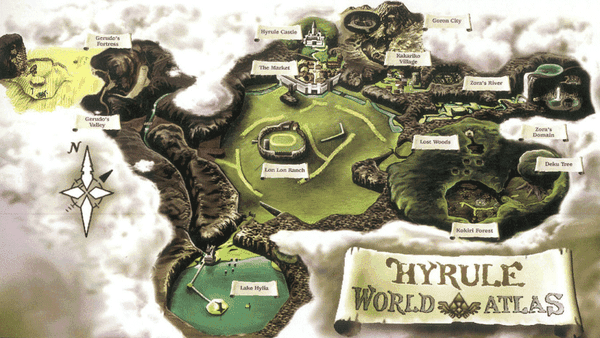
Viewed from above, Hyrule's modular design is obvious.
Imagine blowing away that fog and discovering more
pieces of the puzzle.

Imagine a prelude act to GTA IV with Nico hiding out in a cabin on some bleak snow swept farmland in Eastern Europe. Cold. Desolate. Big beard. Maybe he has to go hunt a rabbit (cue gunplay tutorial). He’s alone and frozen, cut off from civilisation. Exploring yields no surprises, just more emptiness.

Cut to his arrival by boat to The Big Apple. The sun glints off Miss Liberty’s dome and the skyscrapers offer a teeming maze of opportunities. The bridges are open and you’re free to explore. The stage is set, the orchestra engaged. Now let’s see if you can dance…

Framing the city in this way aligns player and protagonist motivation; we are both itching to explore this new environment. Rockstar should let us do so from the off (and they now have with GTA V).

One area where they do excel is streaming a huge, perpetual space. San Andreas is still breathtaking in this regard and advancing tech has allowed huge worlds to be engineered. Team Ico created an incredible, desolate kingdom in Shadow of the Colossus on PS2. As with Wind Waker’s overworld, traversing it gave time for reflection – more poignant here as the player begins questioning their motives for killing the colossi – but unlike Nintendo’s game it was tarnished by technical issues. The land was too vast for the hardware and the frame rate damaged the player’s perception of it. Rareware’s later N64 titles suffered similarly. Perfect Dark and Banjo-Tooie pushed the console beyond its limits and returning to those games now is jarring. Framerate aside, Tooie in particular suffered from a surplus of everything – moves, collectables and space. Levels were labyrinthine and easy to get lost in. Though shot through with the team’s trademark charm (and Grant Kirkhope’s wonderful music), it’s hard to enjoy a world where your patience is tested by a chugging frame rate and overwrought design.

Thatgamecompany’s Journey provides a perfect example of a compelling environment working within very narrow parameters. The game is as linear as life and pregnant with narrative, though it's rarely explicit. There’s not one line of text or dialogue. The locations echo Team Ico’s take on desolation but the ambition is tempered to preserve the player experience. Running away from the mountain across the dunes will only get you so far before sandstorms blow you back. It’s a crude device, one of only a handful that remind players they’re playing a video game, but the desert is so enchanting you forget you’re stuck in it. The sand is a joy to trudge and surf through. When I first met a fellow traveller I tried to say hello by writing my name in it. My moveset was limited to a jump button and a restorative ping! but the space itself was the tool – location and language – and a beautiful one too.


It’s dangerous to go alone...SHARING AND CELEBRATING THE SPACE
Journey’s land is a place best shared. The first time you sight a stranger is confusing as you try to work out who or what it is. Then you discover they’re just like you – just another person trying to find their way in the world. The social dimension can be transformative. When given a companion and a shared objective, an environment’s role in creating atmosphere is aided through collaborative experiences whether they involve huddling behind a rock in a blizzard to restore energy, dodging green shells or bandying together to battle the undead horde. The farmhouse from Left4Dead is burnt in my memory not because it’s a special or memorable structure but because I spent hours dug in there with three friends, strategising and scouting the best vantage points, covering blind spots, scrambling onto the roof and blasting the infected until the rescue vehicle arrived. The house was meticulously designed, of course, but my affection comes from the actions facilitated by that design rather than the building itself.

Deeds done in a place can create an affinity with it and more than once I’ve finished a great game and felt a little empty. Not because it was deficient in any way or the ending was unsatisfying, but because for all my efforts I don’t get to enjoy the peace I’ve brought about. After hours spent liberating the world, I rarely get to kick back and enjoy it. My experience is solely the catastrophe, solely the drama. Having watched the credits I’m invariably returned to the File Select screen and the game forgets I’ve already won. Hyrule is forever in a state of impending doom that I am powerless to affect no matter how many times I thrash Ganon.

Imagine defeating him and riding into town a hero, being offered the key to the city and basking in the glory a little bit. Imagine taking Zelda for a picnic or playing with the kids in Kokiri Forest. Imagine having new ways to enjoy the places I’ve saved. Okami gave me such an opportunity when I returned triumphant to Kamiki Village for the festival. Fireworks exploded and the jubilant music heralded my victory like the end of Return of the Jedi. It was short-lived, of course, for I was only halfway through the game, but it felt so unusual and fulfilling to see the results of my questing and enjoy some kind of respite. Developers invest so much in building these worlds they should explore the possibilities in expanding your experience meaningfully beyond the endgame. I can’t be the only player to feel deflated when all my heroism results only in New Game+.


Final Zone
Most games for me are one time playthroughs, and that’s fine. Some have narratives that need to be completed but once it’s over, I’m satisfied. Though Eternal Darkness was a story worth finishing, there’s nowhere in there I want to return to. But who wouldn’t want to spend three more days in Clock Town, or a year watching the changing seasons in Oakfield or Click Clock Wood?

Well, perhaps many. Nostalgia weedles its way into all these places and, as anyone who has been met with apathy while trying to share something amazing will testify, it’s crushing to realise that we all experience things and places differently and form bonds for different reasons. For some, Spiral Mountain is just a crude collection of polys and lo-res textures with a Dixie tune on top. It’s pleasant enough but not moving, just like my childhood home is innately significant to only me. I find that sad because I want to communicate and share the feeling these places give me and, more often than not, that’s impossible.

But it’s okay. I can still go back and visit. Every Christmas I return to Freezezy Peak because, well, it’s not quite Christmas without it. Nobody wants to live in City 17. Nuke it and head for them there blue sky hills.


Tuesday, 10 December 2013

Tokyo Stories: Ozu and Pixar accepting the inevitable

Even before I ever watched Tokyo Story, I assumed the title Toy Story was referencing Yasujirō Ozu's 1953 film, though while writing this I could find no reference or allusion to it online. Having passed over such titles as To Infinity and Beyond and Toyz in the Hood, Pixar knocked two letters out of Ozu's classic familial study and had a winner. Toy Story is as much about the toy chest as Tokyo Story is the Japanese capital, and the films share much beyond a name; they both examine abandonment, disillusionment, loss and the changing dynamic of relationships.

Ozu's film follows an elderly couple who make a rare trip to Tokyo to visit their grown-up children who, busy with various mundanities, have little time for them. Only Noriko, their widowed daughter-in-law, makes an effort to entertain them, and the couple are forced to accept that their children have changed and that they cannot expect too much from them.


John Lasseter's 1995 Toy Story and its two sequels follow the relationship between Woody, a pullstring cowboy doll, and his owner, Andy. The toys' desires revolve around being loved and played with and the first film highlights the tension as Woody is supplanted in Andy's affections by Buzz Lightyear, a space-marine action figure. It explores themes of obsolescense, rejection and acceptance that carry into the following films and, arguably, define the trilogy. For the purposes of this piece, I will discuss the three films as one entity.


Both Ozu and Pixar's films share resolutely domestic settings. For all the hijinx of Woody and Buzz's capers, they take place primarily in Andy's house and neighbourhood. When they venture into the outside world they wind up at a day care centre, a petrol station forecourt and a toy store. It's through the eyes and diminutive stature of a toy that these places become prisons, jungles and Raiders of the Lost Ark­-esque warehouses. Ozu's camera shares this angle on the world. It famously remains static and low, observing impartially every character from the same point-of-view. The setting is similarly suburban, opening on a train passing through a sleepy neighbourhood with washing hanging on the lines. A nosey neighbour pops her head in the door and finds Shukichi and Tomi, the two elderly companions, preparing for a trip to the city to see their offspring. Unlike Woody and Buzz, they have watched their children grow and begin their own adventures, but both pairs have experienced rejection as their children need them less with the passing of time. On arriving in the city, the awkward smalltalk highlights the deterioration and redundancy of their relationship. The utility they once had has been lost and they now represent an inconvenience, taking up space and clashing with their childrens' routine and lifestyle. Their daughter, Shige, is embarrassed by their presence, lying to a client in her salon that they're "just friends from the country." Shukichi and Tomi still wish to please - they retire to bed readily at the suggestion they must be tired. They lie awake, but out of the way. Shukichi's genial grin mirrors those of Woody and Buzz when in the childrens' presence. Though rejected, he realises the importance of being there to support them, as does Woody ("What's important is that we're here for Andy when he needs us.") Relationships are outgrown and discarded, and loss of contact is a natural progression. Shukichi tells us of his surprise at how children change and that "a married daughter is like a stranger" but efforts to halt this change result only in heartbreak and loneliness.

Death has a lingering presence in these films. Old friends and toys are lost along the way. Few characters realise the importance of the time they have and value it accordingly, although they pay the notion lip service. Keizo, Shukichi and Tomi's youngest son, recites the advice "Be a good son while your parents are alive," but fails to heed it. He arrives too late to say goodbye to his dying mother and chooses baseball over keeping his grieving father company after the funeral. Only Noriko, Shukichi and Tomi's widowed daughter-in-law, dedicates time to them, perhaps viewing the opportunity as a chance to exercise her devotion to her dead husband. Though well-meaning, she has failed to move on in her own life, tied forever to his memory. Just as Woody resigns himself to a box in the attic, forever dedicated to a past relationship, Noriko has her tiny apartment and her dead love's photograph on the wall. She lies to Tomi, telling her "I'm happy," but Tomi worries that she "should have had a better life," urging her to move on. "You may be happy while you're still young," she says, "but as you become older you'll find it lonely." Noriko's effort to prevent the decay of relationship and memory is futile, as she admits when she tells Shukichi of her loneliness at the end.


The narrative crux of Toy Story is surmised in the second film with Jessie's flashback montage, the most explicit example of the breakup anxiety that permeates the trilogy, distilled to two and a half minutes. We witness her owner, Emily, inevitably grow up and away from her, then rediscover and discard her as an adult, leaving her in a box on the roadside. We see for the first time a painful and final ending, not merely the prolonged hiatus of a box in the attic. Jessie tells us "you never forget kids like Emily or Andy...but they forget you," and the whole trilogy hangs on the acceptance of this fact. Woody dearly wants to be involved in his kid's life and we see him clutching the telephone with Andy on the line, desperate to be noticed and relevant, but unable to communicate due to strict social rules. These rules are broken only with friends or in extreme circumstances (eg. to frighten Sid into 'playing nice'). Shukichi is similarly unable to speak with his children, only with his friends - his wife and the men he drinks with when he is turned out of his daughter's house. Neither protagonist is capable of expressing their feelings and are forced to watch their children grow distant. The parent/toy analogy is evident when Andy's mum sees his empty room and breaks down telling him "It's just I wish I could always be with you." Woody does eventually accept the inevitable, partly when he rejects 'immortality' (ironically a lifetime encased in glass in a Tokyo museum) and realises "life's only worth living if you're being loved by a kid," and, ultimately, when he himself faces the end of his relationship in the third film.


In Tokyo Story, this transience is captured with the image of Tomi walking on the hill as her grandson plays in the grass. The scene recalls the dance with Death from The Seventh Seal. Tomi, dressed in black, is silhouetted against the sky and we are shown the generation gap and the progress of time. She wonders if she'll still be there when the child grows up. Protagonists in both films know and even spout the 'life is short' truisms and clichés. Andy's mum reminds us "toys don't last forever". Woody's romanticism is countered by Potato Head's gruff cynicism and the pragmatism of Hamm ("Let's see how much we're going for on ebay.") Stinky Pete confronts Woody with reality when he asks "How long will it last, Woody? Do you really think Andy's going to take you to college, or on his honeymoon?" Even Buzz, having gone through his own journey of self-discovery in the first film ("You are a child's plaything!"), accepts the end is coming. Woody slowly learns that he can't delay the inevitable - he "can't stop Andy from growing up, but [he] wouldn't miss it for the world."

Woody consoles himself that "when it all ends, I'll still have ol' Buzz Lightyear to keep me company." Tokyo Story mirrors this buddy sentiment with Shukichi and Tomi, though Ozu takes their relationship to its inexorable human conclusion, a place where Pixar can't bear to go. Death splits the partnership and exposes Shukichi to a loneliness that Woody will never encounter. Though Pixar do explore the notion in the recycling plant scene when the toys face (and accept) a fiery end, even here they are together. Rejection is one thing, but beloved characters never face adversity alone. Even the troubled Lotso is consigned to his fate on a trucker's front grille with some comic relief for company. Pixar addresses themes of loneliness in several of their films but the overriding message is one of hope and salvation through friendship. Wall-E begins as a lone figure in a desolate landscape, but his is an initial state that is resolved by the end of the film. It is also our introduction to the character - we don't have a three-film emotional investment in him. Likewise, as affecting as Up's opening montage is, we're familiar with Carl for only a few minutes before he is widowed, and he soon finds himself with company, whether he likes it or not.

Noriko's final exchange with Kyoko, Shukichi and Tomi's youngest and unmarried daughter, shows romanticism giving way to wisdom and acceptance. Disgusted with her older siblings' behaviour, Kyoko complains about their selfishness. Noriko explains "they have to look after their own lives...children become like that, gradually." "Isn't life disappointing!" Kyoko exclaims. "Yes," comes the reply.

Ultimately, however, Woody's faith and devotion earns him a 'second' life with Bonnie. The final shots of Tokyo Story and Toy Story 3 both echo their respective beginnings and alude to life going on, with the train once again rolling through the suburbs, neighbours still calling by and the clouds hanging in the sky as they did on the wallpaper in the first Toy Story, but Shukichi experiences solitude and indifference where Woody goes forth to new adventures with the old gang. As Shukichi's neighbour and family insist on reminding him, "you will be lonely."


Friday, 15 November 2013

Wish You Were Here... part 2


Having looked previously at Music and Cohesive Ecosystems, part 2 continues exploring ways digital environments are made to feel like intriguing, living spaces.

The illusion of life...ANIMATION
Imagine a static Green Hill Zone where the water didn’t fall and the rings didn’t spin and the TVs didn’t buzz. Sonic, however beautifully drawn, would be running through a dead space. The dancing sunflowers and endlessly cascading waterfalls on the horizon add weight and tie the world together convincingly. A simple looping animation gives the illusion of life just as it did in the intro shots of early cartoons. Animated backgrounds appeared on 8-bit hardware but they really flourished in the arcade and the 16-bit era. SNK Neo Geo beat-‘em-ups especially highlight how beautiful art and a few looping frames can make a location really pop.

And in order to sell that world, the characters must tally with it. IEpic Yarn Kirby is made from the same material as his surroundings and his animation couples with the base environment to make the simplest interactions satisfying: threads give under his weight as he lands; pulled cords draw platforms closer; patches rip off to reveal passages under the quilted façade, bulging as he walks beneath. The embroidered take on the familiar elemental settings is charming enough but the real joy comes from watching Kirby lurch and transform into a car with a double-tap or begin skating on ice, pirouetting to change direction. My moveset is minimal, but it doesn’t feel restrictive. I can’t affect or modify the world much but the animation makes it a satisfying place to inhabit nonetheless. Spaces mirroring real-world visuals and physics present a challenge to designers. Filling a room with destructible objects is all well and good but the bare space that remains once you’ve compulsively incinerated every last crate/barrel/panel is usually a hollow, uninviting one - a problem compounded in First Person Shooters when your protagonist isn’t onscreen to provide visual interest. Seeing the player character impacting the environment convincingly gives it a persuasive tangibility, and again, this becomes even more complicated when representing a 'realistic' character.

The original Banjo-Kazooie is my most replayed game. Nuts & Bolts boasted a fantastic
vehicle building system but was let down by dull missions and the weight of expectation.
Nutty Acres was so beautiful you were almost content just cruising around testing your
toy box creations. Almost. Nintendo Land uses a similar patchwork art style to great effect.
Good character animation makes you invest in a scene. I could watch Banjo’s backpack for hours, bouncing with each plod through the field grass, and it makes me forgive/forget that this grass is actually one large textured plane with collision toggled off. Conversely, watching my character ‘skate’ through Albion’s beautiful grasslands in Fable II was alienating and it took time for me to accept that ‘quirk’. This is one reason MMOs remain unattractive to me – the fidelity of the world is too often negated by simplistic animation and character behaviour. NPCs run into walls and get stuck on scenery. They cast spells repeatedly and repeat lines and say things entirely out of context. In time I’m sure I could appreciate Skyrim for what it does well and celebrate the meme-friendly incongruity, but accepting those limitations seems at odds with the beauty and potential of the world at a macro level. Being drawn deep into an MMORPG is a frightening prospect knowing how engrossing they can be and how obsessed I can get. Exploring a living, populated world that evolves irrevocably over time would be fascinating but I dare not enter. One does not simply walk away from WoW.


Blue skies...RIVULETS & MEADOWS>SEWERS & CORRIDORS
Admittedly, I’m a sucker for blue sky in games and perhaps it’s unfair to condemn areas designed to elicit discomfort or oppression. If Ravenholm were an idyllic haven, it would conflict with the narrative drive to get-the-hell-outta-Dodge. Valve’s uninviting environments are still engaging and the bleakness of City 17’s concrete makes the escape to the mountains in the following episodes all the more striking. Resident Evil 4 was full of stunning locales that delivered a nail-biting and varied experience but, fun as it was, I’m not rushing to revisit Salazar’s Castle. It served its purpose beautifully. Now point me at the blue sky…

Valve don't want me rolling out the picnic blanket in Ravenholm. Check out Electric Blue Skies
for some great virtual photography from Half-Life 2 and many others
But pretty sunsets and mountain ranges alone don’t make me want to visit a place. I spent a few hours on Crysis’ tropical island marvelling at the foliage and the water (and I royally shat myself when the shark began circling). As a playground for emergent gameplay it was interesting, but I got lonely and bored. Give me a bear and bird bounding around Treasure Trove Cove any day. Give me Mickey Mouse marching through the Enchanted Forest on the Mega Drive or the 64-bit mist over Lake Hylia before sunrise (something the 3DS remake couldn’t quite recapture). That mist made me feel the crispness of the morning, the possibilities of a new day.


Impossible is everything...MEANINGFUL INTERACTION
Beauty alone can’t make a space compelling – it needs to be mechanically motivating. Non-interactive set dressing looks great but ultimately disappoints. Perfunctory backdrop detail is easily (and often unavoidably) exposed when the player is forced to search for the interactive component. Fumbling around to discover which of the cupboards actually opens ironically tests my suspension of disbelief in a way that highlighting said element does not. Watching Tom & Jerry cartoons from the ‘40s, the viewer can quickly identify objects in the environment that the characters will interact with in any shot. The background plates have a washed-out painterly appearance under the outlined animated elements. Rather than take you out of the scene, it’s actually rewarding to recognise that the poker by the fireside is about to become significant – it fosters anticipation of what’s coming next. As with video games, it’s vital that the viewer quickly understands what’s important. Making the background façade indistinguishable from interactive elements exposes the unreality of the scene because players are unable to perform the simplest of tasks. A door! Oh, it’s just a texture on the wall. An apple hanging from a tree! Maybe I can…no, just set dressing. A poker by the fire!? Wow, that’d be fun.

What to do, what to do...
Now I don’t expect fully functioning PCs in the shady corporate office I’m infiltrating but I want my character to be able to do something with them, even if it’s touching the mouse to get rid of the screensaver. The glowing mission critical object was born to guide players through all the non-interactive shit, but one has to ask if said shit is really needed. Are those banks of inactive PCs contributing enough tonally to outweigh the frustration of non-interactivity? The glowing object and breadcrumb trail are fudge solutions and rarely have any narrative context. Navi, annoying as she was, was a clever answer to multiple design challenges. Targeting enemies and highlighting POIs in a 3D space were handled by one system in the guise of a contextually relevant character. In a full library she could locate the one book you needed and it would make sense. Without her you’re left to look for clues in camera angles (borrowing a filmic device) or to follow the glowing breadcrumbs or shiny object. Fine, but why not just put the book on a table and stop pretending?

The whole library is faked to create atmosphere. Developers are intent on making visually credible worlds but rarely have time and resources to create non-critical content. Therefore the player is presented a plastic feast, nailed down to maintain the mood. In the ‘90s the shock of seeing environments realised so beautifully muted the issue. Resident Evil's prerendered backdrops created and preserved tension successfully as dioramas but their limitations were evident once the novelty wore off. The fully 3D environments of following instalments have created new problems. Blundering into the scenery (gun drawn), blindly tapping and testing the surroundings for goodies you know are hidden in random locations kills the mood the developers have crafted and tests players’ patience. In Revelations, a Metroid-style scanner (the contextually legitimate sibling to the glowing object) does its best to maintain a sense of player accomplishment that the glow might strip away but risks making the whole shebang feel like work. Making every cupboard in an environment interactive is within the scope of the current gen but time and resources are required to fill them. And is the equivalent of searching for lost car keys off the critical path worth recreating? Overlook a lockpick in Bioshock Infinite and maybe you’ll miss an audio tape, losing out on a fascinating narrative nugget. I played that game for the story, so it had me obsessively hoovering resources from desks and cupboards. It became a real chore. It made me nostalgic for Rapture. When does fidelity stop adding to the environment and detract from the core experience? (And on the subject of fidelity, why can’t my mutha-fuckin’ RPG obliterate that puny lock!?)

[F] Search. [F] Search. [F]-[F]-[F]-[F]-[F]...
I don’t need a meaningful system behind every object but I want something to justify its existence in the world. Deus Ex let me login to PCs and access emails, and I could uncover more of the story myself. The audiotapes in the original Bioshock were a beautiful contrivance but how long can these techniques continue to convey narrative before they pall? Who’s dropping these personal logs conveniently in my path to stumble upon? And in chronological order too! The Navi-like companion/guide became a cliché almost immediately.

Is it even fair to call these ‘devices’ problems? Art needs direction. I’m not irritated when a director uses his lens to highlight a dress hanging in a protagonist’s wardrobe or when an author has a character improbably reveal vital plot points. Concise storytelling demands framing and coincidence. The issue lies with the fact that I’m being presented possibilities in a video game. The illusion of choice is advertised and I feel short-changed when I discover my options are severely limited. Of course Batman is The World's Greatest Detective - my nan would be if she had Detective Mode in her specs! The cowl tech provides context for the glowing item, but really? Sherlock doesn't need any of that shit. The very best narrative games are quickly forgiven because the story engages you so well you ignore inadequacies in the peripheral environment. Unfortunately video games aren’t renowned for the quality of their writing and picking the world apart is all too easy when you’re bored and looking for something to do.